Eating Out in Paris: Etiquette, Prices, the Carafe d'Eau
Eating Out in Paris: Etiquette, Prices, the Carafe d'Eau
In short. Paris restaurants follow strict hours: lunch 12:00-14:00, dinner 19:30-22:30. On Sunday many are closed. The carafe d'eau (tap water in a pitcher) is free by law in every restaurant — you have to ask for it explicitly with "une carafe d'eau, s'il vous plaît," otherwise the waiter offers you mineral water at a price. Bread is usually included. Tipping is not mandatory because the 15% "service compris" is already included in the bill, but rounding up is appreciated. Meat doneness has to be ordered in French: bleu (raw), saignant (rare), à point (medium), bien cuit (well done). You ask for the bill with "l'addition, s'il vous plaît" — it never arrives unprompted. Always say bonjour upon entering any place.
Eating out in Paris is one of life's pleasures. But it's also a small minefield for those who don't know the unwritten rules. Things like service hours, the story of the carafe d'eau you're entitled to for free but that nobody will mention if you don't ask, tipping that works differently from the US or other countries, and a series of micro-rituals that make the difference between being treated like just another tourist or like an honored guest. Let's get it all straight.
What time do you eat at a Paris restaurant?
French restaurants are not open all day like some others: they have very defined service hours, and outside those hours you simply don't eat. Lunch (déjeuner) is between 12:00 and 14:00, with peak around 12:30-13:00. After 14:00 the kitchen closes. If you arrive at 14:15 and sit down, the waiter will politely tell you the service is over, and may at most offer you a coffee or a dessert.
Dinner (dîner) starts around 19:30 and runs until 22:30 (brasseries later, until 23:00 or midnight). Before 19:00 restaurants are practically empty, and in many the kitchen isn't open yet. Dining at 20:30-21:00 is perfectly normal — that's the "right" hour.
Between lunch and dinner there's the "trou" (hole): from 14:30 to 19:00 in most restaurants the kitchen is closed, even if the place stays open as a bar. If you're hungry in that window you need to go to a brasserie (which often has the kitchen open non-stop), a café (sandwiches, croque-monsieur, salads), or a boulangerie (bakery-patisserie, which sells sandwiches and quiches at all hours).
On Sunday many central restaurants are closed. Especially in the evening. If you want to go to a specific place, always check — even with a phone call, because Google Maps sometimes gets holiday hours wrong.
Is the carafe d'eau really free in Paris?
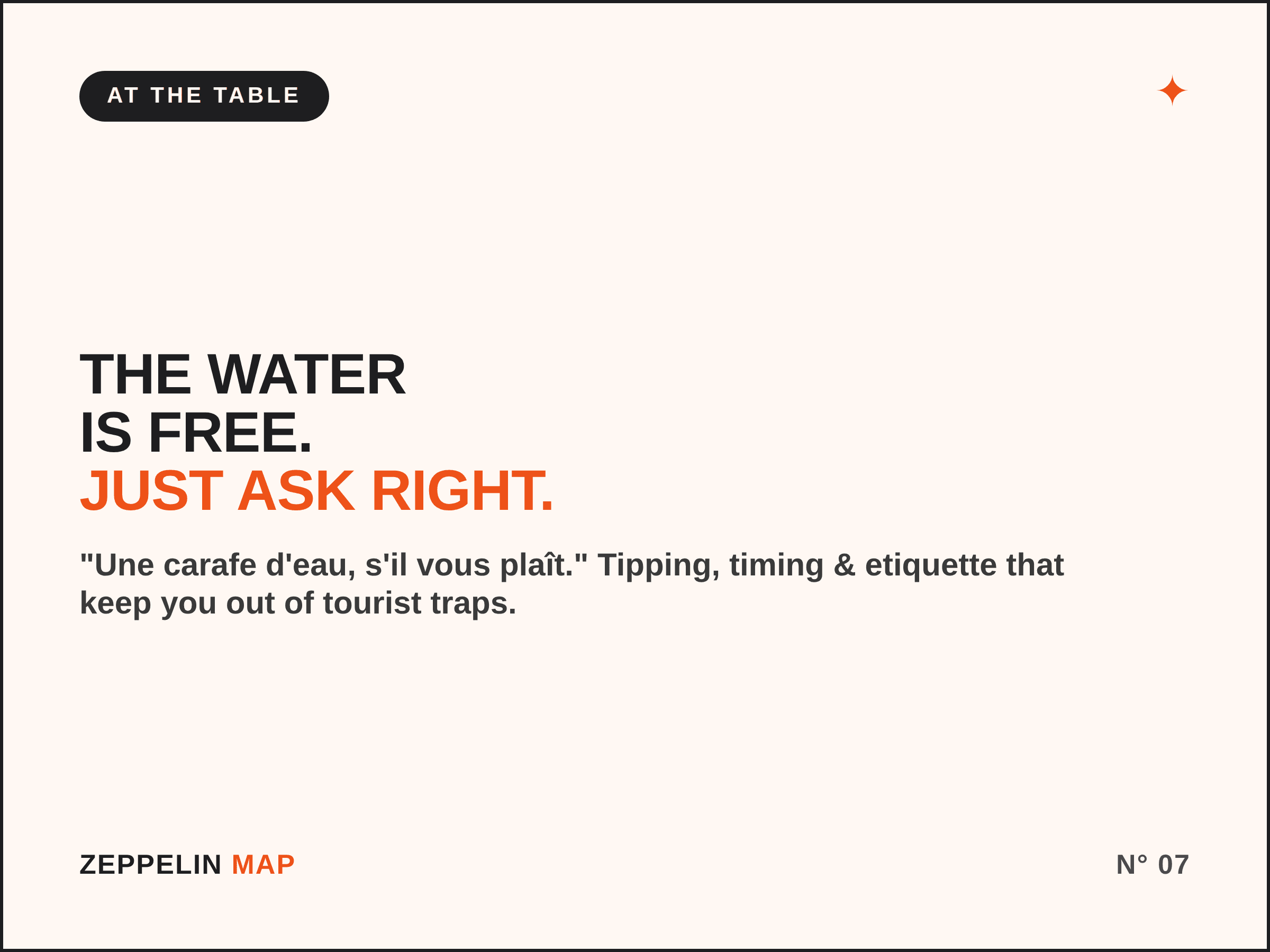
Yes, by law. In France every restaurant must provide free tap water to its customers. The right comes from the decree of June 8, 1967 on price display in restaurants, and was reinforced by law n° 2020-105 of February 10, 2020 (the so-called "anti-waste law"), article 77, which since January 1, 2022, also requires restaurant owners to clearly indicate on the menu or in the dining room that customers can request free drinking water.
The water is called carafe d'eau and is a glass or steel pitcher full of cold tap water, brought to your table at no extra cost.
The problem is that no waiter will offer it to you spontaneously. When they ask what you want to drink, they propose "une bouteille d'eau plate ou gazeuse?" (a bottle of still or sparkling water?) — which costs €4-7. If you accept, you pay. If instead you say "une carafe d'eau, s'il vous plaît," they bring it free. Period.
You just have to ask — and it's perfectly legal and legitimate. It's not considered cheap, it's a common choice even among Parisians themselves (especially at lunch, where they want speed and don't want to pay €6 for Evian). There's only one exception: the carafe d'eau is owed to you only if you're consuming something. In a café where you've ordered an espresso, water is owed. In a café where you walked in without ordering anything just to ask for a glass of water, they can refuse.
Paris tap water is excellent and safe (they call it Eau de Paris, the public network). The carafe d'eau isn't a "cheap choice," it's a sensible one.
Is bread included at the restaurant?
Yes, bread in France is included with the cover and is free. The waiter brings a basket with a few slices of baguette or country bread, and if it runs out you can ask for it to be refilled for free: "Encore un peu de pain, s'il vous plaît" and they bring more. No extra on the bill.
Bread in France is an institution, and the baguette is a UNESCO heritage. Even in the most affordable restaurants, the bread is of good quality.
How do you read a French menu?
The menu of a French restaurant has a precise structure: there's the Entrées section (starters, but more substantial than appetizers — terrine, foie gras, composed salad, soupe à l'oignon), the Plats (proper main courses, with meat or fish, usually accompanied by an integrated side), the Desserts, and the Fromages (cheeses, which many French take instead of dessert or alongside it).
Almost every restaurant offers a formule or a menu at a fixed price: usually two or three courses chosen from a selection. It's almost always better value than ordering à la carte. At lunch (formule du midi) you start at €18-25 for two courses, at dinner €30-50 for three. If instead you order à la carte, each dish is €14-30 for plats, €8-15 for entrées and desserts.
The plats du jour (daily specials) are usually the freshest choice and sometimes aren't even written on the menu: the waiter recites them aloud, in fast French. If you don't catch it, just calmly ask "vous pouvez répéter, s'il vous plaît?" — and if they don't speak English and you don't speak French, point to a spot on the physical menu and ask "qu'est-ce que c'est?" (what is it?).
How do you ask for meat doneness in French?
In France if you order a steak or any meat, the waiter will ask "quelle cuisson?" (which doneness?). There are four options:
Bleu is practically raw, warm only on the surface. Saignant is rare, the inside raw and red. À point is medium, the inside pink. Bien cuit is well-done, no pink.
The French eat their meat much rarer than people from many other countries. If you ask for "à point" thinking you'll get a medium cook the way you know it, they often bring it bloodier than you're used to. If you want something closer to a typical medium, ask for "bien cuit". If you really want it well done, "très bien cuit".
How do you ask for the bill at a Paris restaurant?
Unlike in some countries, in France the waiter doesn't bring you the bill at the end of the meal: they wait for you to ask for it. Even if you've finished twenty minutes ago and your eyes are shaped like "let's get going." You have to signal you want it, with a hand gesture and the phrase "l'addition, s'il vous plaît" (the bill, please).
When it arrives, the bill includes everything: the price of the dishes, VAT, and a line called "service compris" which is the mandatory tip for the staff (around 15%, already included in the price). So technically the tip is already paid.
Payment is made with credit card (they accept Visa, Mastercard, including foreign cards) or cash. American Amex cards are accepted in many places but not everywhere — better to have a Visa as backup. Apple Pay and Google Pay work in places with contactless POS terminals.
Do you have to tip at a restaurant in France?
No, tipping is not mandatory in France. The "service compris" is already in the price: technically you're not required to leave anything, and waiters earn a fixed salary (unlike in the US, where they depend on tips).
That said, leaving something extra is appreciated if the service was good. The informal rule is to round up: if the bill is €47, you leave €50; if it's €78, you leave €80. Small amounts (€1-3) are perfectly normal and offend no one. A 10-15% tip on top, like in the US, is considered generous but isn't standard practice.
In cash, leave the difference on the table. With a card, if the terminal allows, you can add a small extra; or tell the waiter "gardez la monnaie" (keep the change) if you pay and leave a few euros.
The small unwritten rules of table etiquette
At the table in France, there are rules that differ from elsewhere. Hands must stay above the table during the meal, not on your lap. It's an aristocratic heritage (showing your hands meant showing you had no weapons).
Bread is broken with the hands, never with a knife. And it's placed directly on the tablecloth next to your plate, not on a bread plate (which doesn't exist).
Eating french fries (frites) with your hands is considered rude in a serious restaurant: use the fork. Only in fast-food and very casual bistros is it acceptable.
The aperitif before dinner is a tradition: a glass of wine, a beer, a kir (white wine with crème de cassis) accompanied by olives or nuts. It's done at the table or at the bar before sitting down to eat.
Wine is ordered at the table. The wine list can be encyclopedic; if you're not an expert, ask the waiter "une suggestion?" pointing to the dish you ordered. For those who prefer to save, the vin de carafe (or "pichet de vin") is the house wine served in a pitcher: 25-50 cl at €4-15, excellent value for money.
Can you have a cappuccino after dinner in Paris?
Technically yes, but it's considered odd. In France coffee is taken after dessert, not with it. In fact, almost always the waiter asks you at the end of the meal "un café?" as the last thing. If you say yes, they bring an espresso (called simply "un café"). If you want something different:
Un café crème is a long espresso with foamed milk, similar to a small cappuccino. Un noisette is an espresso with a drop of milk. Un déca or un décaféiné is the decaf.
A real cappuccino exists only in very touristy places. The French don't drink cappuccino after meals — it's considered a breakfast drink, and only with a hearty breakfast. Don't order coffee with milk (café au lait) after dinner: in a restaurant at dinner it sounds odd and the waiter will raise an eyebrow.
How to find a good restaurant in Paris
Paris has thousands of restaurants, and quality varies enormously — especially in hyper-tourist zones (Champs-Élysées, Île de la Cité, at the foot of the Eiffel Tower) where it's easy to fall into tourist traps with mediocre food at high prices. The zones with the best value remain the "lively" neighborhoods frequented by locals: the Marais, Canal Saint-Martin, Saint-Germain, Bastille, Belleville, parts of Pigalle.
When you plan a day and need to slot in a lunch break or a dinner, Zeppelin Map (the iOS transit navigation app for Paris, developed by Anaximae SASU) suggests restaurants near your stops based on the time of day. If you're out and about around lunchtime (roughly noon to 3 PM), the app proactively proposes restaurants near your route, computing a stop along the way. Same for an afternoon snack break (4-6:30 PM) and dinner (7-11 PM). It works as an assistant: you don't have to search manually, it tells you "look, there's a good brasserie right nearby" while you're on your tour.
And if you book a restaurant that's a bit out of the way, the app calculates how to get there with the right transit and tells you whether metro or bus is better, locking the final stop to the reservation time so your day ends right where dinner is.
The number one mistake with Paris waiters
The waiter in France is not "your servant," they're a professional who often studied the trade and is proud of it. Treating them with condescension, snapping fingers, raising your voice are behaviors that earn you glacial service. Treating them with a "monsieur" or "madame" at the start of the sentence, smiling, saying "merci" and "s'il vous plaît," instead, often brings you a smile, honest advice, a little extra care.
Paris waiters have a reputation for being rude. The truth is they react to how you treat them. Be polite, speak calmly, and you'll be surprised how helpful they are.
FAQ — Frequently Asked Questions about Paris restaurants
What time is dinner in Paris?
In Paris dinner (dîner) is between 19:30 and 22:30 in restaurants, until 23:00-midnight in brasseries. Before 19:00 many restaurants have the kitchen still closed. Dining at 20:30-21:00 is the normal time for Parisians.
Is the carafe d'eau really free in French restaurants?
Yes, by law. The decree of June 8, 1967 requires French restaurants to provide free drinking water to customers who consume something. Law n° 2020-105 of February 10, 2020 reinforced the obligation, requiring since 2022 that this also be indicated on the menu. You need to ask for it with "une carafe d'eau, s'il vous plaît".
Do you tip at restaurants in France?
Not required. The 15% "service compris" is already included in the bill. Leaving extra is appreciated if the service was good — the rule is to round up (€1-3 is normal). Never an obligation, never pressure.
How do you ask for the bill at a restaurant in French?
You say "l'addition, s'il vous plaît" (the bill, please) with a hand gesture to get the waiter's attention. The bill in France doesn't arrive spontaneously: you always have to ask for it.
What does "à point" mean for meat doneness in France?
"À point" is medium cooking in French, with a pink interior. The other options are bleu (practically raw), saignant (rare), bien cuit (well done). The French eat their meat rarer than many: for a medium-equivalent cooking, ask for "bien cuit".
What does "service compris" mean on the French bill?
"Service compris" means the tip for the staff (about 15%) is already included in the price of the dishes. It's not a separate item to pay, it's an indication that the law requires to be displayed.
Can you go to a Paris restaurant without a reservation?
It depends on the place and the moment. For bistros and brasseries at lunch on weekdays usually you can without booking. For gastronomic restaurants, for Friday and Saturday evenings at popular spots, and for evenings in areas like the Marais or Saint-Germain, booking is strongly recommended, even a day in advance.