Politeness in France: the Bonjour, the Vous, the Lifesaver Phrases
Politeness in France: the Bonjour, the Vous, the Lifesaver Phrases
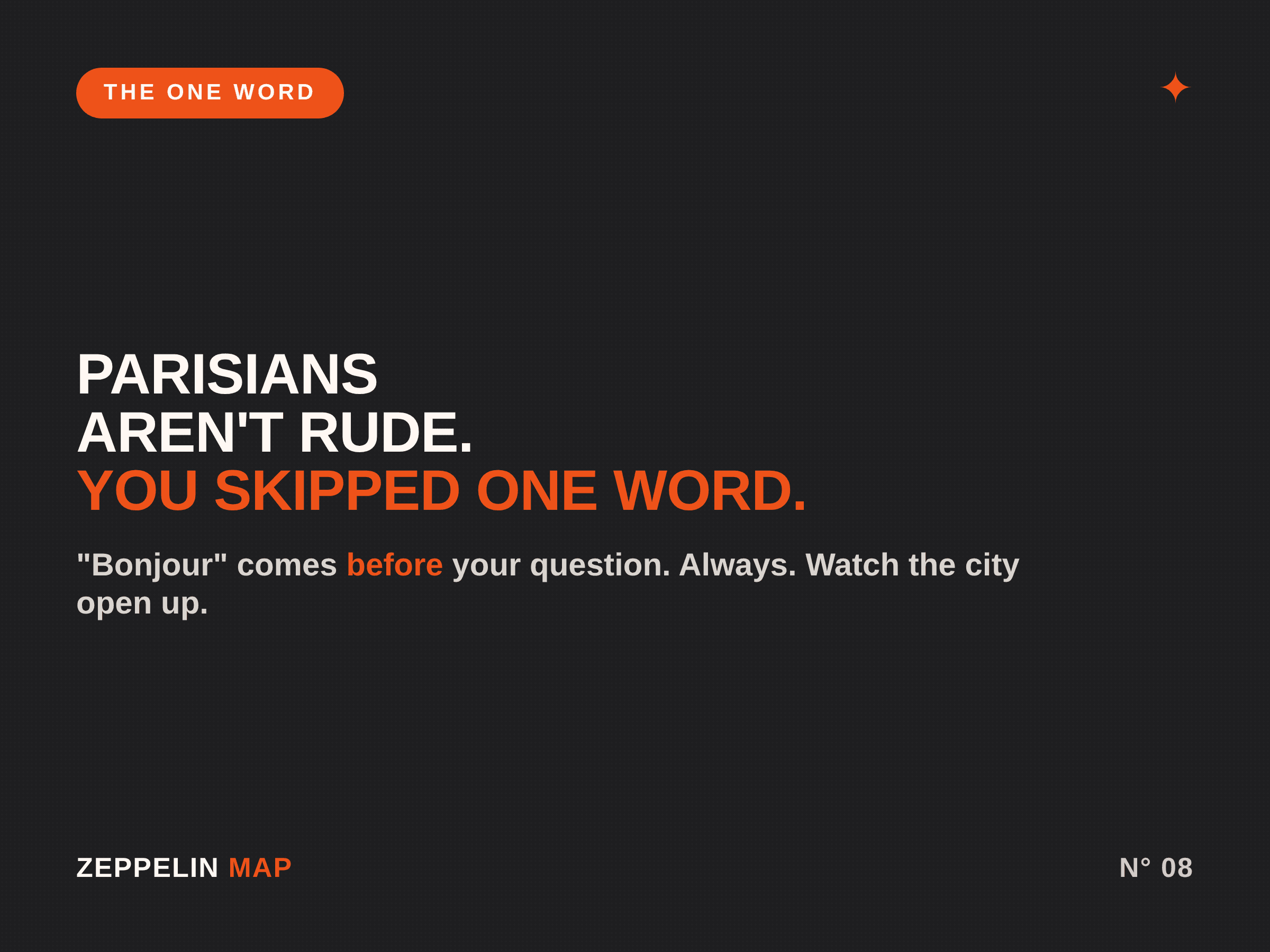
In short. In France, the first word out of your mouth when you enter a shop, restaurant, café, or elevator must be "bonjour" (after sunset: "bonsoir"). Skipping the bonjour is considered the fundamental rudeness and will cost you glacial coldness. As a tourist, always use "vous" (formal), never "tu," unless speaking with children under 12. The five magic words you'll use constantly are bonjour, pardon, s'il vous plaît, merci, au revoir. When you ask for something, always start with "Bonjour, excusez-moi de vous déranger...". The famous "Parisian rudeness" is almost always a mirrored reaction to the rudeness the tourist, without realizing it, brought first.
There's one word in France that, if you forget it, gets you off on the wrong foot in any situation. It's not "merci." It's not "s'il vous plaît." It's "bonjour".
It sounds trivial, but it's not. Understanding how French politeness works — when you use it, in what order, with what tone — is the difference between being treated warmly or with that famous "Parisian coldness" everyone talks about. The truth nobody tells you is simple: Parisian coldness often doesn't exist — it's a reaction to a behavior the French perceive as rude without you noticing. And nine times out of ten the cause is exactly skipping a "bonjour."
Why do you always have to say bonjour when entering a shop in France?
In France, when you enter a shop, a café, a restaurant, a taxi, an elevator with another person, in any place where there's a human interaction, the first word out of your mouth must be "bonjour". Not "sorry, where's the bathroom." Not "I'd like a coffee." Not "how much is this?". Bonjour. Period.
Once you've said bonjour and the other person has replied bonjour, then you ask your question. It's a microsecond of exchange, but it completely changes the register of the conversation. Without the initial bonjour, you've already landed in the "rude tourist" box.
The cultural reason is simple: in France, mutual respect is shown by acknowledging the other person's existence before asking them something. Skipping the greeting means treating the clerk, the waiter, the driver as an extension of the service rather than as a person. For the French, it's a small humiliation, and they respond with the same coldness.
The reverse is also true: when you greet first with a warm, smiling bonjour, even the most curt clerk often softens. It's truly worth it.
When do you say bonjour vs bonsoir?
"Bonjour" is used until sunset, "bonsoir" after, around 6:00-7:00 PM. It's not a hard rule: if you walk into a café at 5:30 PM in January when it's already dark, "bonsoir" is fine. In summer at 7:30 PM with full sun, "bonjour" still works.
In an elevator with a stranger, bonjour in the elevator too. It sounds excessive but it's the norm. When you leave, "au revoir" (goodbye) or "bonne journée" (have a good day) / "bonne soirée" (have a good evening) depending on the time.
How do you ask for something politely in French?
The "elegant" way to ask for something in France has an almost ritual structure. Say you want to ask for directions in the metro. The complete formula is:
"Bonjour, excusez-moi de vous déranger, est-ce que vous pourriez me dire où se trouve la sortie 4, s'il vous plaît?"
(Hello, sorry to bother you, could you tell me where exit 4 is, please?)
Obviously you don't need to recite all this like a theater actor. But that's the concept: bonjour, a small courtesy formula ("excusez-moi," "pardon"), the question in the conditional (more polite than the imperative), an "s'il vous plaît" at the end. A shorter version is fine too: "Bonjour, excusez-moi, où est la sortie 4 s'il vous plaît?". The essential thing is never to ask "out of the blue" without having greeted first.
What are the 5 French words I need to know in Paris?
There are five words you need to say at Paris without thinking, in every interaction:
Bonjour when you enter or meet someone. Pardon when you pass in front of someone, bump someone, or want to get someone's attention to ask something. S'il vous plaît at the end of every request. Even a small one. Merci when you receive anything, even a smile. Au revoir when you leave.
If these five words don't come out spontaneously after two days in Paris, you're doing something wrong. They're the salt of daily life in France.
When do you use "tu" and when "vous" in French?
French has two forms of "you": "tu" (informal, for friends and family) and "vous" (formal, for anyone you don't know or who's in a position of respect). For a tourist the rule is simple: always use "vous", in any situation, with anyone who isn't a small child.
Even with people your age. Even with the young barista. Even with the waiter in jeans. The "vous" isn't cold: it's the polite default. If you go to "tu" too soon, you sound intrusive. If the person wants to switch to "tu," they'll tell you ("on peut se tutoyer?" — can we use tu?), and from then on go with "tu."
Only exception: with children under about 12, "tu" is normal. And among very young people (under 25) there's a tendency to switch to tu more quickly. But as a tourist, "vous" always, with everyone.
What is the "bise" and when is it done?
The bise is the small kiss on the cheek with which French people greet those they already know. It's not a real kiss — it's a cheek-to-cheek contact with a small audible "pft." In Paris it's two kisses (one per cheek, starting from the right), in other regions of France it can be three or four.
As a tourist, you don't do the bise with strangers. You only do it if you're invited to French friends' home and you're introduced to other friends — in that context the bise is the greeting. In professional or business situations, the handshake (poignée de main) is still the norm.
If you're not sure what to do, let the other person decide: do they extend a hand? Handshake. Do they lean in for the bise? Bise. Improvise.
How do you apologize in French?
The French use elaborate apologies sparingly. A French apology is dry. If you bump into someone, you say "pardon" or "je suis désolé(e)" — that's enough. If you want to emphasize it, "je suis vraiment désolé(e)". But repeating a thousand times doesn't have a good effect: it sounds insincere or melodramatic.
Same for thank-yous. "Merci" is enough. "Merci beaucoup" if you want to emphasize. "Merci infiniment" if you want to be almost formal. But avoid thanking five times in a row: for a French person it's strange and sounds almost fake.
Why do Parisians seem "rude" to tourists?
There are situations where the French seem cold or curt, and you don't understand why. Let's look at the most common ones.
In a shop: you walked in without saying bonjour. For the clerk, you've been rude, and they return the favor with minimal service. Solution: always bonjour upon entering.
At a restaurant: you called the waiter snapping your fingers or with "psssst!". It's almost an insult. The right way is to slightly raise your hand and make a discreet gesture, or say "s'il vous plaît" loud enough but politely. Never "Garçon!" — it's a paternalistic term considered outdated.
On the street: you ask directions of someone in a hurry without preamble ("Where's the Eiffel Tower?"). The reply is often a shrug. If you start with "bonjour, excusez-moi," the same person stops and explains in detail.
At a café: you sit at an outdoor table and nobody comes for ten minutes. It's not rudeness, it's the system: waiters don't constantly check outdoor tables. You have to make a gesture or say "bonjour" when someone passes.
In all these cases, French "rudeness" is actually a mirrored reaction. Change your first step, and everything else changes.
Lifesaver phrases for tourists in Paris
Even if you don't speak French, these few phrases open doors and smiles.
Bonjour, parlez-vous anglais? (Hello, do you speak English?) — politely asks if you can continue in English, before surprising them with it.
Excusez-moi de vous déranger, mais j'ai besoin d'aide. (Sorry to bother you, but I need help.) — magic words when you're lost.
Je ne parle pas bien français, désolé(e). (I don't speak French well, sorry.) — a disarming honesty that almost always transforms the other person's tone.
Combien ça coûte? (How much does it cost?) — shopping basics.
Je voudrais... (I'd like...) — replaces "I want," which in French sounds aggressive.
C'est combien? (How much is it?) — when you want the bill quickly at a café.
Je peux avoir l'addition, s'il vous plaît? (Can I have the bill, please?) — at a restaurant.
Je suis perdu(e). (I'm lost.) — disarming and honest.
How to get around Paris without asking strangers for directions
A side note worth making: using an app like Zeppelin Map (the iOS transit navigation app for Paris, developed by Anaximae SASU) that walks you through stop by stop dramatically reduces the situations where you have to stop a stranger to ask for directions. For Parisians passing by it's a relief (they too prefer not to be stopped every few meters), and for you it's a saving of social stress. There are still some occasions left — asking a clerk the price of something, or the bus driver if they pass a certain stop — and for those, the six "bonjour, excusez-moi" of your day are the small investment in politeness that pays you back with local-level treatment instead of tourist treatment.
The small final secret
There's a trick few tourists discover. When you interact with a Parisian and start with a warm bonjour, continue in English (or gesturing) but with a polite tone, and finish with a big "merci" and an "au revoir, bonne journée" — the majority of Parisians become warm. Waiters recommending an extra dish, clerks helping you find the right size, drivers telling you two stops later where to get off.
"Parisian rudeness," in the end, is a mirror. If you present yourself with politeness, you receive politeness. If you present yourself bluntly, you get the same back. It's the same city, the same country: only the way you make contact changes.
FAQ — Frequently Asked Questions about French politeness
Do I really have to say bonjour in every shop in France?
Yes, always. It's the fundamental French politeness rule. When you enter a shop, café, restaurant, taxi, or elevator with strangers, the first word must be "bonjour" (or "bonsoir" after sunset). Skipping the greeting is considered rude and will earn you glacial treatment.
When do you use "vous" and when "tu" in French?
As a tourist, always use "vous" (formal) with anyone you don't personally know, regardless of age. "Tu" is used only with friends, family, or children under 12. If the person wants to switch to "tu," they'll tell you by asking "on peut se tutoyer?".
What should I say when entering a café in Paris?
You should greet with "bonjour" (before about 6 PM) or "bonsoir" (after sunset), wait for the waiter to acknowledge you, and only then make your request using "s'il vous plaît" at the end. Example: "Bonjour, un café s'il vous plaît".
How do French people greet each other when they already know each other?
Among people who already know each other, they do the bise, a small cheek-to-cheek kiss. In Paris it's two kisses, in other French regions three or four. With strangers and in professional contexts, a handshake is used. With newly introduced people it depends on context: let the other person initiate.
Why do Parisian waiters seem rude?
Often it's not rudeness, but a mirrored reaction: French waiters react to the way you treat them. Snapping fingers, calling "garçon!", not greeting upon entering, raising your voice — all of this reads as rudeness and is met with coldness. Greeting with "bonjour," asking with "s'il vous plaît," and thanking with "merci" almost always bring back politeness.
What are the most useful French phrases for a tourist?
The basic phrases that save every situation: Bonjour (hello), S'il vous plaît (please), Merci (thank you), Pardon / Excusez-moi (sorry), Au revoir (goodbye), Parlez-vous anglais? (do you speak English?), Je ne parle pas français (I don't speak French), Combien ça coûte? (how much does it cost?), L'addition s'il vous plaît (the bill please).
Is it true that French people don't speak English?
False stereotype. Most Parisians under 50 speak decent English, especially in tourist areas and in service staff. But in France there's a strong culture of the national language: asking immediately in English without even attempting a "bonjour" or a "parlez-vous anglais?" is considered rude. By starting with politeness in French, you almost always get a reply in fluent English.